
How to Verify a Cosmetics Manufacturer's Formulation Capability
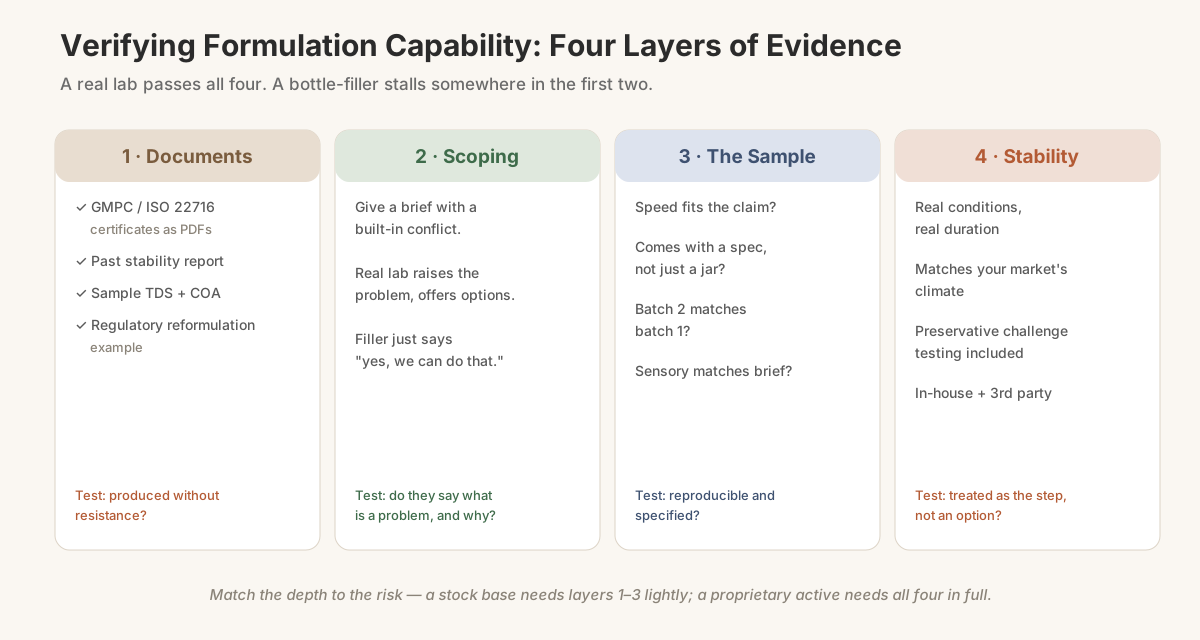
Chart by GZ Cosmetics Lab · Free to reuse with a link back to this page.
Every cosmetics factory says it has a strong R&D team. The claim costs nothing to make and is impossible to disprove from a website, so it tells you almost nothing. What separates a genuine formulation lab from a factory that fills bottles with a supplier's stock base is not what they say — it is what they can show you, how their samples behave, and whether their stability data holds up. This guide is about verifying formulation capability with evidence, so you can tell the difference before you commit a development budget rather than after your first production run drifts.
It is written as the buyer's counterpart to the development side of the business. If you are still deciding how much development your product actually needs, the scoping logic in our guide to what a cosmetic CDMO is and when you need one comes first; this guide assumes you have decided you need real formulation work and now have to confirm a candidate can deliver it.
Why "We Have a Strong R&D Team" Is Not Evidence
The gap this guide closes is specific. A large share of factories that present themselves as formulators are, in practice, running a catalogue of pre-made bases from ingredient suppliers and adjusting colour, fragrance, and label. That is a legitimate and often sensible service — it is fast and cheap — but it is not formulation development, and paying development prices for it is a bad trade. The problem is that from a brochure, a video tour, and a friendly sales call, the two look identical. Verification is the process of forcing the difference into the open, and it rests on four kinds of evidence: documents, scoping behaviour, sample behaviour, and stability data. None of them can be faked cheaply, which is exactly why they work.
Layer 1: The Documents a Real Formulator Can Produce
Start with paperwork, because it is the fastest filter and a capable lab produces it without friction. Request these, and treat hesitation as data:
- Certification documents, not just logos. A logo on a website is not a certificate. Ask for the actual GMPC and ISO 22716 certificates as PDFs, with the certifying body and validity dates visible, so you can confirm the scope and that they are current. To hold ourselves to the same standard we ask of any partner: our GMPC and ISO 22716 certificates (HBPCER20260353 and HBPCER20260352) are issued by Intertek and valid to 15 July 2029, and you can verify them yourself at certs.intertek.com.cn rather than take our word for it. A real lab treats this as routine, not sensitive.
- A finished-product stability report. Ask to see a redacted stability report from a past project — not your formula, an existing one. The point is to confirm they run stability programmes at all and know what one looks like. A factory that only fills stock bases often cannot produce one, because the supplier ran it, not them.
- A sample technical data sheet (TDS) and a sample certificate of analysis (COA). These are the documents that accompany a real batch. Their format, completeness, and the parameters they track tell you whether there is genuine quality control behind the formula or whether documentation is an afterthought.
- Evidence of regulatory reformulation. Ask for an example of a formula they adjusted to meet a specific market's rules — a restricted ingredient swapped for a compliant alternative, a concentration brought under a regional cap. This is a capability stock-base fillers rarely have, because it requires understanding the formula, not just ordering it.
You are not auditing the content of these documents like a regulator. You are confirming they exist, are current, and are produced without resistance. The friction of the request is itself the test. Verifying that those documents are genuine is a separate step with its own method — see our guide on how to find a skincare manufacturer you can trust, which covers checking a business licence against the national enterprise register and confirming a certificate number with the issuing body rather than the factory.
Layer 2: How They Scope the Work Tells You If They Understand It
Give a candidate a brief with a deliberate tension in it — two actives that do not naturally coexist, or a claim that is heavier than the ingredient list can honestly support — and listen to how they respond. This is the single most revealing test, and it costs nothing.
A real formulator raises the problem before you do. Ask for a serum with both pure vitamin C and niacinamide at meaningful levels, for instance, and a capable lab will tell you those two want different pH environments, so combining them at strength usually means compromising both, and will offer the real options: split them into two products, or use a stable vitamin C derivative that sits in the same near-neutral range. A stock-base filler will simply say "yes, we can do that," because they are not thinking about the chemistry — they are thinking about the order.
The same test works on claims. State that you want to claim a dramatic, fast result, and watch whether they connect the claim to what would actually have to be substantiated, or just agree. A partner who tells you where your brief will run into trouble is demonstrating that they understand the formula well enough to develop it. A partner who agrees to everything is telling you they will hand you whatever the supplier base already does and let you find the gaps in market. The willingness to say "that specific combination is a problem, here is why, here are your options" is the clearest signal of real capability there is.
Want to stress-test a manufacturer's formulation claims?
Send us your brief with its hardest constraint — the actives that fight, the claim that is a stretch, the market rule that complicates everything. We will tell you what is genuinely achievable and where it needs to become two products, so you can compare our answer against anyone else's.
Layer 3: What the Sample Itself Tells You
A sample is not just a texture to approve — it is a piece of evidence about how the lab works. Read it accordingly.
- How fast did it arrive, and does that fit the claim? A "fully custom" formula that arrives in three days is almost certainly a lightly adjusted stock base, which may be exactly what you want, but you should know that is what it is. Genuine custom development runs to 10–15 days for a first sample with stability data, and often more than one round. Suspiciously fast custom work is worth a direct question, not blind approval.
- Does it come with a specification, or just a jar? A capable lab sends a sample with its parameters — pH, viscosity, appearance targets. A jar with no numbers is a jar with no quality reference to hold production against later.
- Does batch two match batch one? Request a second sample of the same formula. Reproducibility across batches is the practical proof that they control the formula rather than approximate it. Drift between two small batches predicts worse drift at production scale.
- Does the sensory experience match the brief, or match whatever they had? If you asked for a lightweight gel suitable for a humid market and got a rich cream, they may be steering you toward an existing base rather than building to your specification.
Layer 4: The Stability Data You Must Insist On
Stability and preservative testing carry published list prices at several labs, which is useful context when a quote bundles them without a breakdown — see our line-by-line look at formulation and testing costs.
Stability testing is where formulation capability becomes non-negotiable, and it is the layer most often skipped under time pressure. A formula that looks perfect on the bench can separate, discolour, lose potency, or fail its preservative system weeks later — and you will discover it in market, on your customers, if it was not caught first. Insist on it, and know what to insist on:
- Real conditions, real duration. A stability programme runs the product through controlled temperature and time to predict shelf life. It cannot be honestly compressed into a few days; the study takes as long as it takes. A partner who offers to "confirm stability" overnight is confirming nothing.
- The conditions that match your market. If you sell into a hot, humid region, temperate-climate stability data does not cover you. Heat and humidity stress both the formula and its preservative system harder, so tropical markets need the product designed and tested against those conditions from the start, not certified for them at the end.
- Preservative efficacy, specifically. Ask whether the stability programme includes preservative-system challenge testing. A formula can be physically stable and still fail microbiologically, which is the failure mode that actually harms users.
- Who runs it. Confirm whether testing is in-house, at a certified third-party institution, or both. Third-party validation on efficacy and safety claims carries more weight than a factory grading its own work. We run accelerated and long-term stability studies as part of quality control, and support third-party SGS testing on request, precisely so a claim does not rest on our word alone.
The rule of thumb: if a manufacturer treats stability testing as optional, negotiable, or instant, they are not a formulation partner regardless of what the brochure says. A real lab treats it as the step that protects both of you. And when the report does arrive, the word "pass" on the cover page is not the finding — what was tested, in what packaging, under which conditions, against criteria set in advance, and signed off by whom are. Reading a stability testing report works through those five entries before you accept a shelf life.
Reading the Ingredient and Supply Side
Two more checks separate depth from surface. First, the ingredient side: a lab that develops formulas keeps a working relationship with the raw-material world rather than a single catalogue. Application-lab relationships with major ingredient houses — in our case BASF, Symrise, and Croda — mean access to current actives and the technical support to use them correctly, which is the difference between formulating with today's ingredients and reselling last decade's base. Ask what actives they have worked with recently and how they source them.
Second, the delivery side, because a large part of real cosmetic performance is not the active but how it is delivered. A lab with genuine capability can talk concretely about how it stabilizes and delivers a difficult active, and can point to the technology behind it rather than gesturing at a buzzword. Where that rests on protected technology, you should be able to see it described plainly — our own work sits on a proprietary supramolecular delivery platform backed by multiple granted patents, documented on our delivery technology page rather than left as a marketing phrase. The test is specificity: a capable partner explains the mechanism at a level you can verify, while a filler changes the subject.
The Red Flags That Tell You to Walk Away
The four layers above tell you what capability looks like. It is just as useful to know what its absence looks like, because weak formulators rarely announce themselves — they reveal it in small, consistent ways. Treat any cluster of the following as a reason to slow down and dig, not to place an order.
They say yes to everything. The single most reliable warning sign. A partner who never pushes back on a brief, never flags a claim that is hard to substantiate, and never mentions a trade-off is not being agreeable — they are not engaging with the chemistry at all. Real development involves constraints, and a lab that understands the formula will name them early.
They cannot show you a stability report, even a redacted one. If a manufacturer cannot produce a single example of a stability programme from a past project, it usually means the supplier ran it, not them. That is the signature of a filler who orders stock bases rather than a lab that develops formulas.
They quote a full custom formula in a day, at a suspiciously round number. Genuine development scoping takes time because it involves ingredient selection, compatibility checks, and a realistic sample-and-revision plan. An instant flat quote usually means they are pricing a stock base with a new label, not the development you asked for.
Certificates arrive as images, not verifiable documents. A logo or a screenshot is not a certificate. If you ask for the PDF with the issuing body and validity dates and receive friction or a low-resolution image instead, the claim may not survive scrutiny. A certificate you can verify at the issuing body's site — for GMPC and ISO 22716, that is certs.intertek.com.cn — is the only kind that counts.
They will not name the testing they run or who runs it. Vague assurances that a product is "fully tested" without specifying stability duration, preservative challenge testing, or the lab involved are not evidence. A capable partner tells you exactly what is tested, under what conditions, and whether it is internal, third-party, or both.
None of these is disqualifying in isolation — a small lab may legitimately be cautious about sharing documents until an NDA is signed. But two or three together, especially the first two, are a consistent pattern, and the pattern is what you are reading.
What Skipping Verification Actually Costs
It is tempting to treat this checklist as optional diligence you can shortcut to save a few weeks. The arithmetic argues otherwise, because the failure does not surface during development — it surfaces after you have paid for a production run and put the product in front of customers.
A formula that was never properly stability-tested can separate, discolour, lose active potency, or fail its preservative system weeks or months into its shelf life. By then the cost is not a rejected sample; it is a full batch you have already funded, packaging you have already printed, inventory sitting in a warehouse, and — the expensive part — the customers who bought it. Product recalls, marketplace delisting, and the reputational damage of a brand that shipped an unstable product are all downstream of a verification step that would have cost days.
The same logic applies to regulatory verification. A manufacturer who did not reformulate for your target market's rules can leave you holding stock that cannot legally clear customs or list on the marketplaces you were counting on. That is not a formulation problem you discover on the bench; it is a shipment you discover at the border. Confirming, before you commit, that a partner understands the destination market's restricted-ingredient list and concentration caps is far cheaper than discovering the gap after production.
This is the real reason the verification is worth the effort: it moves the point of failure from after the money is spent to before. Every question in this guide is designed to surface a weakness while it is still just a conversation.
Match the Verification Depth to the Project
Not every project justifies every layer, and over-auditing a simple job wastes everyone's time. Calibrate:
| Project type | Layers to run | What you are actually buying | Where it fails if you skip |
|---|---|---|---|
| Stock or lightly customised base | Layer 1 documents + a reproducibility check | Execution, not development | Batch-to-batch drift you only notice after the second order |
| Genuinely custom formula | All four layers | Formulation judgement | The scoping test and stability data are where custom projects succeed or quietly fail |
| True development or a proprietary active | All four, plus IP and engagement terms | A development partnership | Ownership of the resulting asset, and whether it is exclusive to you |
For a stock or lightly customised base, the broader vetting around it is covered in our guide to choosing a cosmetics manufacturer in China; for development partnerships, the IP and engagement questions are in the CDMO guide.
The verification is only as deep as the risk. A first stock-formula SKU does not need a stability challenge study you commission yourself; a proprietary active going into a multi-market range does.
Frequently Asked Questions
How can I tell if a factory really formulates or just fills bottles?
Give them a brief with a built-in conflict — two actives that fight, or a claim heavier than the ingredients support. A real formulator raises the problem and offers options before you do; a bottle-filler says "yes, we can do that" and hands you a stock base. Back that up by requesting a stability report and a TDS from a past project: a lab that only fills bases usually cannot produce one because the supplier ran it.
What documents should I request to verify formulation capability?
Actual GMPC and ISO 22716 certificates as PDFs with body and validity dates, a redacted stability report from a past project, a sample TDS and COA, and an example of a formula they reformulated to meet a specific market's regulations. You are confirming these exist and are produced without resistance, not auditing them like a regulator. The friction of the request is the test.
Why does stability testing matter so much?
A formula that looks perfect on the bench can separate, discolour, lose potency, or fail its preservative system weeks later — and if it was not caught in a stability programme, you find out in market on your customers. Insist on real-condition testing over a real duration, conditions matching your market's climate, and preservative-efficacy challenge testing. Any partner offering instant stability confirmation is confirming nothing.
Is fast sampling a good sign or a bad sign?
It depends what you were promised. A stock or lightly adjusted base arriving in a few days is normal and fine — if that is what you are buying. A "fully custom" formula arriving that fast is almost certainly not custom. Genuine custom development runs to 10–15 days for a first sample with stability data, often across more than one round. Match the speed to the claim.
How much verification does my project actually need?
Match it to the risk. A stock or lightly customized base needs only certification documents and a batch-reproducibility check. A genuinely custom formula needs the full set, especially the scoping test and stability data. A proprietary active or true development project needs all of that plus IP and engagement terms settled in advance.
If you would like to test a formulation claim rather than take it on faith, send us your brief with its hardest constraint and we will tell you what is genuinely achievable, what needs to become two products, and what stability and testing it requires. Start by seeing how we specify a technically demanding format on our freeze-dried serum set, or request a quote with your project in mind.
Ready to Start Your Project?
Tell us your product requirements. Our technical team responds within 24 hours with a detailed quotation.