
Private Label Hair Oil vs Hair Serum: Finish, Dose and Packaging Before Sampling
If your range needs one leave-in finishing product for the lengths and ends, the useful question is not "oil or serum?" in the abstract. It is: which finishing job does your customer need done first, and would a second SKU do a genuinely different job or just repeat the first one under another name? Settle that before sampling and the supplier can develop one clear product instead of two near-identical ones.
This guide is for brand owners, product developers and buyers planning a private label leave-in for hair fibre. It covers how to choose a first direction, how to tell whether an oil and a serum in the same range are really different, and what to put in the brief so the OEM/ODM partner can explain its formula and packaging trade-offs. It does not cover scalp products, hair-growth or hair-loss positioning, treatment claims or formulation recipes.
Scope: mid-lengths and ends, not the scalp
Everything here concerns leave-in products applied to the mid-lengths and ends of the hair fibre to change how it looks and feels: shine, smoothness, softness, frizz appearance and ease of combing. A product designed to be applied to the scalp is a different brief, with different questions about residue at the roots, applicator design and claim boundaries. If that is your actual project, our guide to scalp serum development covers it, and the decisions below will not transfer cleanly.
Keeping the two apart matters in the brief as well. A lengths-and-ends product should say where it goes and where it should not go. "Apply to mid-lengths and ends, keep away from roots" is a positioning decision that shapes texture, dose and pack, not just a line on the back label.
"Oil" and "serum" are market names, not formula definitions
Many buyers start with an assumed split: oil means anhydrous and botanical, serum means water-based or silicone-based. In the market, both names are used for a wide range of products. A product sold as a hair oil may be built mainly on light emollients rather than plant oils. A product sold as a serum may contain no water at all. Some "serums" look and feel like oils, and some "oils" are blended to feel almost dry.
That has two practical consequences for a private label project:
- The name does not tell you performance. Calling a product an oil does not make it more nourishing, and calling it a serum does not make it lighter or more technical. Finish, weight and residue come from the finished formula on the target hair, at the intended dose, from the intended pack.
- The name does not settle testing or preservation. Whether a finished product contains water, how it is dispensed and how it is used all feed into what the supplier needs to evaluate. You cannot conclude from the word "oil" that a product needs no preservation review, or from the word "serum" that it needs a particular system. Ask the supplier how its proposed formula and pack are assessed.
Use the name as a consumer-facing signal of what the product is for and how it feels. Then brief the supplier on the job, not the label.
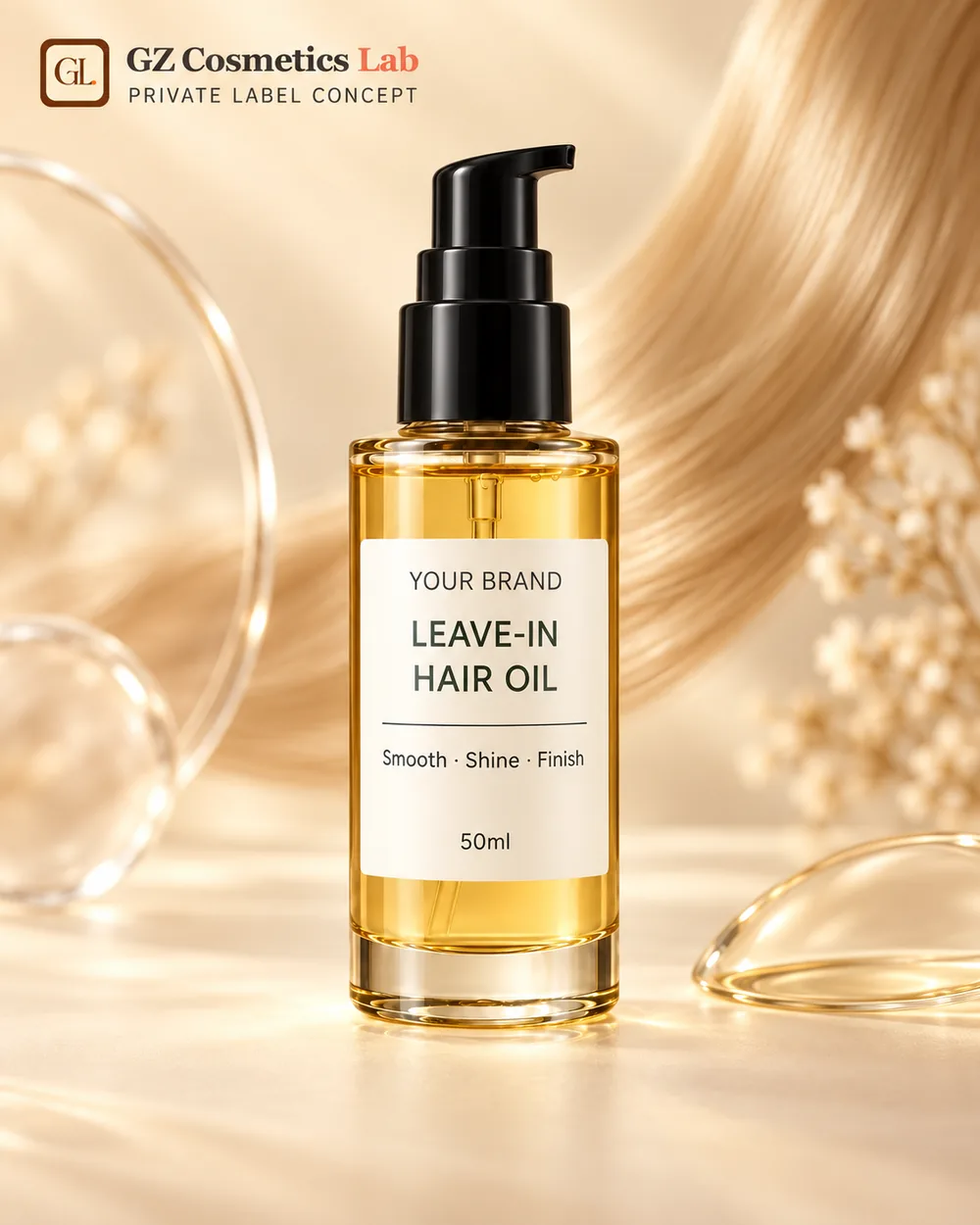
Hair oil development direction
Lightweight, repair-look or shine-focused concepts to review against your brief.
Explore the hair oil direction →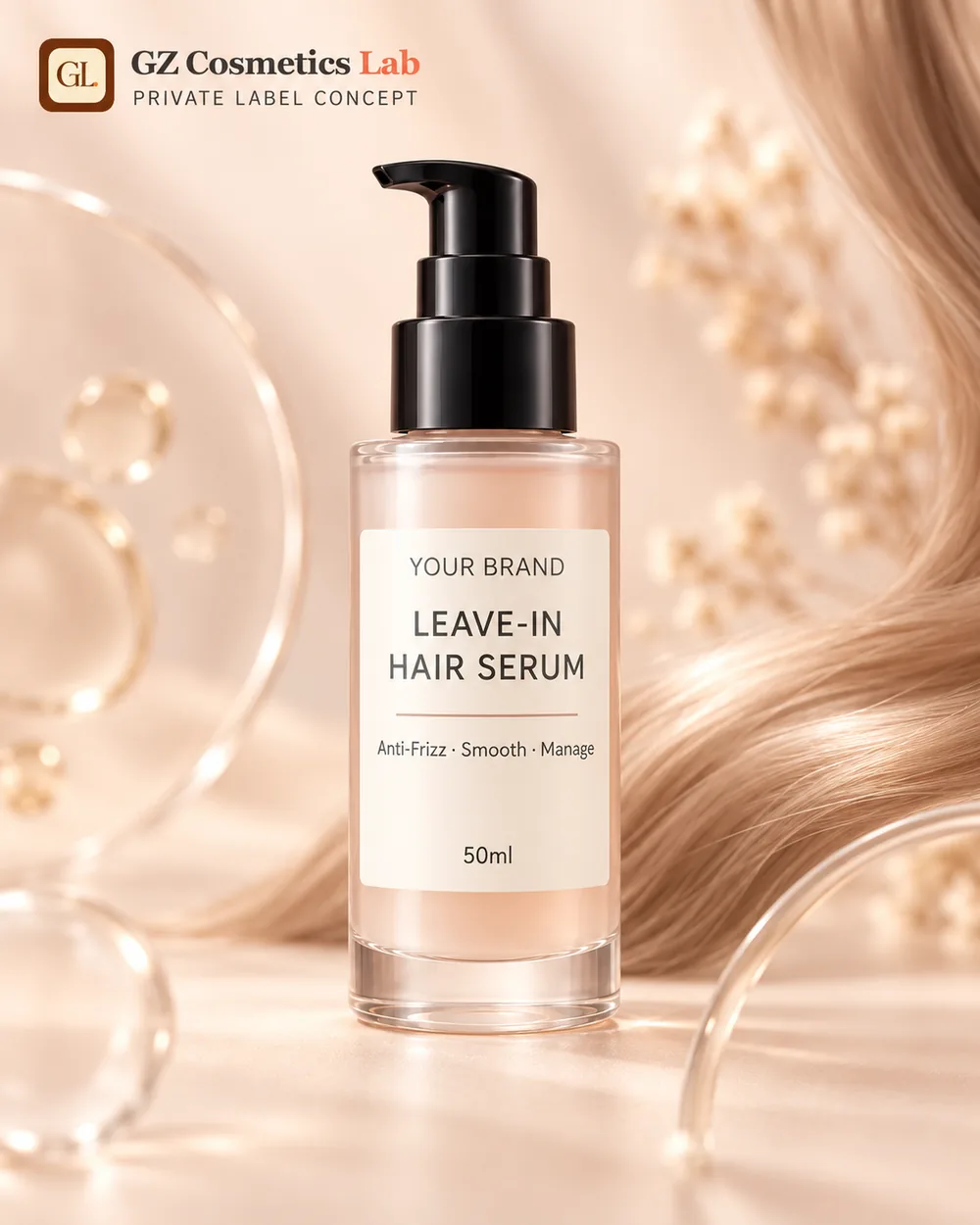
Leave-in serum development direction
Anti-frizz, heat-styling support or lightweight repair-look concepts, subject to project review.
Compare the serum direction →Concept illustrations, not photographs of supplied or tested batches. The pictured packs and 50 ml labels are illustrative, not confirmed specifications or performance evidence.
Five decisions that separate an oil from a serum before any sample exists
Two finishing products are only meaningfully different if they differ on some of these points. If your two candidate SKUs answer all five the same way, you are looking at one product.
1. Target hair and the problem the customer describes
Start with how the customer describes the problem in their own words. "My ends look dry and dull after colouring" and "my fine hair goes flat if I put anything on it" are different briefs even if both customers want shine. Hair diameter, curl pattern and chemical history all change how much product the hair can carry before it looks greasy or coated. Write down the hair type you are designing for first, not every hair type you would like to sell to.
2. Routine step and whether the hair is wet or dry
Decide where the product sits in your customer's routine: on towel-dried hair before drying or styling, on dry hair as a last step, as a touch-up during the day, or more than one of these. Each step changes the brief. Ask the supplier to evaluate spreading, intended dose and feel separately on damp and dry hair; do not assume the same formula behaves identically under both conditions. A product applied to dry hair as a finish is judged immediately on shine, weight and how it feels on the hands.
If a step involves a blow-dryer or heated tools, state that as the intended routine, but do not assume the product protects against heat. On our current serum development page, heat-styling support is one route that needs a selected technology and its own agreed test plan; it is not a default property of any serum base. The same applies to an oil. If heat protection is not part of the claim, the brief should say "used before blow-drying; no heat-protection claim", so nobody designs or labels around a claim you have not paid to support.
3. The finish you want, described in words a panel can judge
"Nourishing" is not a finish. Describe what the hair should look and feel like after use: a visible gloss on the ends, a smooth and soft feel when you run fingers through, no visible separation of strands, no film on the hands, hair that still moves. Then describe the failure you want to avoid, such as heavy ends, stringy curls, a coated feel the next day or a fragrance that lingers too long. Naming the failure mode is often more useful to a formulator than naming the ideal.
A reference product helps. "Lighter than the oil we currently sell" or "similar slip to this market product, with less residue on fine hair" gives the supplier something concrete to work against. Keep any reference product as a sensory reference only; it is not a formula to copy.
4. Application zone and how much product the hair should receive
Ends-only products and products worked through the whole length behave differently. Ask the supplier how the sensory target changes between ends-only application and broader coverage through the lengths; neither the format name nor the application zone alone determines how rich the formula should be. Write the zone into the brief, and state the intended dose as a consumer instruction you would want to print, for example "one to two pumps for shoulder-length hair". Treat that as a target for the supplier to evaluate, not a fixed specification. Whether it is right depends on the finished formula, the pump or dropper output and the hair it is tested on.
5. Dispensing and the role in your range
The pack is part of the product. A pump may support controlled dispensing, but its output needs to be checked with the proposed formula. A dropper may fit a treatment-style presentation, but dose control, pipette handling and residue at the neck still need review. A treatment bottle with a reducer is another option to evaluate rather than assume is more or less precise. Our oil development page lists pump, dropper or treatment bottle options; the serum page lists pump or treatment bottle options. Each remains subject to compatibility with the specific formula.
Then define the product's role in the range. Is it the one finishing step that follows your conditioner or mask? Is it a premium add-on? Is it the product that connects care with styling? A single sentence about role makes it much easier to decide whether a second leave-in has a place.
Illustrative planning example: one customer, two candidate SKUs
This is an illustrative planning example. It is not a tested sample, an actual client project or a quotation, and it does not show results that would apply to every brand.
A brand sells a colour-care shampoo, conditioner and mask to women aged roughly 25 to 45 who colour their hair at a salon several times a year. Customer reviews mention two complaints: ends that look dry and dull a few weeks after colouring, and hair that frizzes in humid weather. The product team proposes adding two leave-ins at once:
| Point | Candidate A: "finishing hair oil" | Candidate B: "smoothing hair serum" |
|---|---|---|
| Customer problem | Dull, dry-looking ends after colour | Dull ends and frizz |
| Hair type | Coloured, medium to thick, some wave | Coloured, all hair types |
| Routine step | Dry hair, last step | Dry hair, last step |
| Finish | Gloss and soft feel on the ends | Smooth, shiny, not greasy |
| Zone | Ends | Mid-lengths and ends |
| Pack | Glass dropper bottle | Pump bottle |
Running the overlap test
Written this way, the two candidates share the same customer, the same routine step and almost the same finish. The differences are a word in the claim ("smoothing"), a slightly wider zone and the pack. On a shelf, the customer would need the label to tell them which one to buy, and the honest answer would be "either". Two products like this tend to split the same purchase, double the packaging and sampling work, and make it harder to explain the range.
The test the team used was simple: can each product be described in one routine sentence that the other cannot also claim?
- A: "A few drops on dry ends as the last step, for gloss on colour-treated hair."
- B, as first written: "A pump on dry lengths as the last step, for smooth, shiny hair." This overlaps with A.
The decision: one SKU now, a second only if it earns a different step
The team chose to develop the oil direction first. The reasoning was that the clearest repeated complaint was dull ends after colour, which is a finishing job on dry hair, and that one well-defined finishing product sits naturally after the existing mask. They then made three changes to the brief:
- Narrowed the hair type. "All hair types" was removed. The first product targets coloured, medium to thick hair, because the team did not assume that the same finish would suit fine hair. Fine hair was noted as an open question, not quietly included; that suitability would need to be evaluated on the proposed product.
- Moved the pack decision behind the dose. The dropper was kept as a candidate because it suits the treatment positioning, but the brief asks the supplier to compare it with a pump on dose consistency and residue on the neck before the pack is fixed.
- Parked the serum with conditions. Candidate B was not dropped outright. It was rewritten as a possible second phase that would only proceed if it did a different job: applied to towel-dried hair before blow-drying, worked through the lengths, aimed at frizz appearance in humid weather, with a lighter feel suitable for finer hair. Its new routine sentence, "A pump through damp lengths before drying, for smoother-looking hair in humidity", does not overlap with the oil. Any heat-protection wording stays out unless that route is selected and tested.
That last point is the real decision. Two leave-ins earn their place when they sit at different steps, on different hair, with different finishes, and a customer could choose between them without reading the small print. When they differ only in name and bottle, merging them into one well-briefed product is usually the stronger plan.
When the opposite answer is right
The same method can point the other way. If the brand's customers were mostly fine, straight hair and the main complaint were flyaways and a lack of smoothness, a light serum-style product applied through the lengths might be the better first SKU, with an ends-only oil considered later for customers with drier, thicker ends. The order depends on the customer's problem and routine, not on a general rule that oil or serum comes first.
Choosing one leave-in or planning two?
Send the target hair, routine step and finish for each candidate. We can review the development direction before you fix the formula and pack.
The brief that came out of the example
Here is how the team wrote the first product brief for its OEM/ODM partner. The content is illustrative and the market and quantity remain explicitly open. It is a development brief, not a specification approved for production or a complete request for a firm quotation.
| Brief item | What the brand wrote |
|---|---|
| Product role | Single leave-in finishing step after the existing colour-care mask; premium tier of the range |
| Target hair | Colour-treated, medium to thick, straight to wavy. Fine hair not targeted in this version |
| Routine step | Dry hair, last step. Optional touch-up on dry ends during the day. Not positioned for use before heat styling |
| Zone | Ends and lower lengths only; label instruction to keep away from roots |
| Finish wanted | Visible gloss on ends, soft feel, strands still separate and move |
| Finish to avoid | Greasy or darkened ends, clumping, oily film left on palms after rubbing in, strong fragrance carry-over the next day |
| Sensory reference | Lighter on the ends than the brand's current competitor reference oil; sensory comparison only |
| Intended dose wording | Target instruction "a few drops or one pump for shoulder-length hair"; supplier to advise once the formula and dispenser are known |
| Ingredient direction | Brand story around a recognisable plant oil is preferred but not required; open to light emollients if they give the finish better. List of brand exclusions attached |
| Fragrance | Soft, matching the existing colour-care line; supplier to advise on how it behaves in this base |
| Claim direction | Shine, softness, smoother-looking and more manageable ends. No bond repair, no heat protection, no treatment claims |
| Pack candidates | Glass dropper bottle or pump bottle; fill size to be proposed against intended use and dispensing output, not borrowed from the rinse-off mask. Final selection follows compatibility and dose review |
| Market and quantity | Still open: the brand must supply its destination market, sales channel and intended quantity per SKU before a comparable quotation can be prepared |
Notice what is not in the brief: no ingredient percentages, no fixed number of drops, no assumption that the product needs no preservation review because it is called an oil. Those are outputs of development, not inputs from the brand.
Formula and packaging trade-offs to ask the supplier to explain
A good brief invites the supplier to explain its proposal. These are the questions that separate a considered proposal from a stock base with your label on it. Each is something to evaluate on the proposed finished product and pack, not something to assume from the product name.
Oil phase: feel, story and change over time
- Which oil phase do you propose for this hair type and finish, and why? Where does a lighter emollient system give a better result than a botanical oil, and where is the trade-off the reverse?
- If a plant oil is used for the brand story, how will it be assessed for odour and colour change over shelf life? Our current oil development page lists oxidation stability, odour and colour change as items checked with the final pack; ask how that is planned for your project specifically.
- What does an antioxidant contribute in this formula, and what still has to be shown by testing the finished product?
Fragrance and colour in the base
- How does the chosen fragrance behave in this base, both on the hair and in the bottle over time?
- If the pack is clear glass, how visible would any colour change be, and would you recommend a tinted or opaque option?
Water, preservation and in-use contamination
- Does the proposed formula contain water or water-soluble ingredients, and what does that mean for the preservation assessment?
- If the product is anhydrous, how do you assess whether a preservative system is needed given the pack and how the user handles it, for example a dropper going back into the bottle or wet hands touching the neck?
- For a serum route, how is preservation, where applicable, assessed together with the chosen pump?
Silicones and "free-from" positioning
- If the brand wants a silicone-free product, what is the sensory trade-off against the finish in the brief, and how close can you get? Our serum development page treats silicone preference as something assessed against the sensory target, which is the right framing.
- Treat silicone-free, botanical or "natural" as positioning choices. They are not, on their own, evidence that a product is safer, gentler or better.
Dispenser: dose, mess and leakage
- Pump or dropper: which gives a dose closer to the intended instruction for this formula, and how consistent is it from first use to near-empty?
- Is the pump seal or dropper bulb material compatible with this oil phase? What leakage, swelling or sticking needs to be checked with the final pack, including in transit?
- Does the dropper leave product on the pipette or neck that makes the bottle oily to handle?
Residue and build-up
- How will residue and build-up be judged on the target hair type at the intended dose, rather than on a hand swatch? The oil page notes that dose and residue should be confirmed on the target hair, and the serum page lists residue and build-up on representative hair types; ask which hair is used.
- For a parked second SKU like the damp-hair serum in the example, what would make its feel clearly different from the oil, and is that difference visible to the customer?
What sample feedback can and cannot tell you
When the first samples arrive, ordinary sensory feedback should follow the supplier's approved intended use and instructions. Your team can record shine, weight, smell and pack handling; this is not a programme of human safety or efficacy testing. That feedback is valuable for choosing between directions and adjusting the brief. It is not a formal stability test, a packaging compatibility test, a safety assessment or evidence for a performance claim such as heat protection or frizz reduction. Keep the two separate in your notes: "the team preferred the lighter version on medium hair" is a sensory direction; "the product is stable in this pump" is a test outcome that the supplier needs to plan and report.
Repair language follows the same rule. Both of our current development pages keep wording at the level of shine, smoothness, manageability and the appearance of damaged hair, and say that permanent repair of internal hair bonds should not be implied without supporting technology and evidence. Use sample rounds to decide the finish. Use agreed testing to support anything you want to print beyond that.
Quick check: one product or two?
Before you send the brief, run each candidate leave-in through these questions. If the answers match, merge the products into one stronger brief.
- Does each product have its own routine sentence that the other cannot also claim?
- Are they used at different steps, such as damp hair before drying versus dry hair as a finish?
- Do they target different hair, or the same hair with a clearly different finish?
- Is the application zone different, such as ends only versus through the lengths?
- Would a customer know which to buy from the front of the pack, without reading the back?
- Does each one have a distinct role in the range, not just a different bottle?
If the answers suggest overlap, first ask what distinct customer need the second product would serve. Sharing a routine step does not by itself make two products redundant: a meaningful difference in target hair, finish or use can justify both. A different pack or a new adjective alone is not enough.
Send a development brief, not a format name
The fastest way to a useful first sample is a brief that names the customer, the routine step, the finish to achieve and avoid, the zone, the intended dose wording, the pack candidates and the claims you will and will not make. With that, an OEM/ODM partner can propose one direction and explain the formula and packaging trade-offs, instead of sending a generic oil and a generic serum for you to choose between.
Our custom leave-in hair oil currently has three development directions: lightweight, repair-look and shine. If your brief points to a frizz, styling-prep or lighter through-the-lengths product instead, compare the custom leave-in hair serum directions: anti-frizz, heat-styling support and lightweight repair-look. All of these are development directions subject to project review, with formula, pack, testing scope and commercial terms confirmed for your project. If the leave-in is part of a wider range decision, our private label hair care overview covers the rest of the category.
When your brief is ready, send it with a quote request and tell us which candidate SKUs you are weighing. We will come back with a proposed direction or the questions needed to prepare one.
Ready to Start Your Project?
Tell us your product requirements. Within 24 hours, our technical team will reply with a quotation or the questions needed to prepare one.