
Scent-Free Skincare: Fragrance-Free vs Unscented Explained
Quick answer
- Scent-free skincare is a loose term for products meant to have little or no smell. In the US, FDA says there is no federal definition for fragrance-free or related terms such as hypoallergenic and for sensitive skin. Brands also use unscented and no added fragrance in different ways, so the front-label wording alone does not settle the question.
- Fragrance-free usually means no ingredient was added to give the product a scent. Unscented usually means the finished product should not smell, and FDA notes that an unscented product may still use fragrance ingredients to mask other odors. Review the full formula and the intended function of each raw material before approving a claim.


What scent-free, fragrance-free, unscented and no added fragrance usually mean
People search for all four terms as if they were the same thing. On a label they often describe different promises. The table below shows how the terms are commonly used. It describes common practice, not legal definitions.
| Label term | What it usually promises | What may still be in the product | What a reader cannot tell from the term alone |
|---|---|---|---|
| Scent-free | The product is meant to have little or no noticeable smell | Masking ingredients, aromatic raw materials, the natural smell of the base | Whether any fragrance ingredient was used, and for what purpose |
| Fragrance-free | No ingredient was added to give the product a scent | Raw materials that smell of themselves, such as some oils, butters or extracts | How the brand treats essential oils and aromatic extracts |
| Unscented | The finished product should not smell of anything noticeable | A small amount of fragrance or masking agent used to neutralize base odor | Whether unscented was reached by leaving fragrance out or by masking |
| No added fragrance | No fragrance blend or perfuming ingredient was added during manufacture | Odor from raw materials, including botanicals with their own scent | Whether the product actually smells neutral |
Fragrance-free and no added fragrance describe what went into the formula. Unscented and scent-free describe what the product smells like. A product can be fragrance-free and still have a noticeable smell, because shea butter, some plant oils and many extracts smell of themselves. A product can be unscented and still contain a fragrance ingredient if that ingredient is there to cancel another smell.
Scent-free on a skincare pack is usually read the same way as unscented: a description of smell. Brands should not treat it as a stronger version of fragrance-free.
Takeaway: Fragrance-free is about ingredients. Unscented is about smell. Neither term tells you everything, so the ingredient list has to do the rest.
There is no single US legal definition
In the United States, FDA states that there is no federal standard or definition that governs the use of terms such as hypoallergenic, fragrance-free or for sensitive skin. FDA's own advice to people with allergies is that checking for those terms is not enough, and that they should read the ingredient panel and avoid ingredients they know or suspect they react to.
FDA's page on hypoallergenic cosmetics makes the same point about a related claim. It says there are no federal standards or definitions for hypoallergenic and that the term means whatever a particular company wants it to mean. Manufacturers are not required to submit substantiation of hypoallergenic claims to FDA. That page is about hypoallergenic, not fragrance-free, but it explains why a free-from or gentleness term on a US pack depends on what the brand can support, not on a government standard.
The masking point is documented twice. FDA's consumer page on fragrances says some products labeled unscented may contain fragrance ingredients, added in just the amount needed to mask the unpleasant smell of other ingredients without giving the product a noticeable scent. FDA's Cosmetics Labeling Guide explains how such an ingredient is declared. A masking agent, meaning an ingredient that covers an unwanted off-odor without adding a discernible odor, may be listed by its individual name or as fragrance. The guide adds that a masking agent present at an insignificant level may be treated as an incidental ingredient, in which case it does not need to appear on the label at all.
So unscented on a US product does not promise that no fragrance ingredient was used, and the label may not show every material that affects smell.
US rules on fragrance allergens are also changing. FDA's page on the Modernization of Cosmetics Regulation Act of 2022 (MoCRA) lists fragrance allergen labeling requirements among the regulations MoCRA requires FDA to establish. Until FDA finalizes that rule, the main US declaration rule is that fragrance may be listed as fragrance. Anyone preparing a US label should check FDA's current position at the time of artwork approval.
How the EU approaches the same question
The EU does not publish a legal definition of fragrance-free either, but it has two tools that affect how a scent-free claim works.
The first is ingredient labeling. The European Commission explains that perfume and aromatic compositions can generally be listed as parfum or aroma, but certain fragrance allergens must be named individually when they are present above set thresholds. Under Commission Regulation (EU) 2023/1545, which amended Annex III of the Cosmetics Regulation, 56 additional fragrance allergens now require individual labeling. The threshold is 0.001% in leave-on products and 0.01% in rinse-off products. Since 31 July 2026, products that do not meet the new rule may no longer be placed on the EU market. Products placed on the market before that date may continue to be made available until 31 July 2028.
The second is guidance on free-from claims. A technical document on cosmetic claims, agreed by the Sub-Working Group on Claims and endorsed by the Working Group on Cosmetic Products, gives best-practice examples for applying the EU's common criteria for claims under Regulation (EU) No 655/2013. The document states that it is not a European Commission document and is not legally binding. Its guidance is still the clearest public statement of how EU authorities tend to read free-from wording. Two points apply directly:
- The claim free from perfume should not be used when a product contains an ingredient that has a perfuming function in the product, regardless of its other functions.
- The claim free from allergenic or sensitizing substances is not allowed, because a complete absence of the risk of an allergic reaction cannot be guaranteed.
The first point matters for masking materials. If a material added to mask base odor also has a perfuming function in the final formula, a free from perfume claim is not appropriate under this guidance, whatever the brand calls that material. Whether a masking material actually perfumes the product depends on the material, its level and the formula, so its function has to be checked case by case. The second point warns against using fragrance-free to imply a product cannot cause a reaction.
Where a smell can come from
Searching an ingredient list for Fragrance or Parfum is a good first step, but it misses several sources of smell. A product can smell because of any of the following.
A fragrance blend. Declared as Fragrance in the US or Parfum in the EU. One word on the label can stand for a mixture of many substances.
Individually named fragrance ingredients. Linalool, Limonene, Citral, Geraniol, Citronellol and similar names may appear separately. In the EU this is often because they are labeled fragrance allergens above the threshold. A product with no Parfum line but with one of these names deserves a closer look.
Essential oils. Lavender, tea tree, citrus peel, rosemary and many other oils give a product a noticeable scent. FDA notes that there is no regulatory definition for essential oils and that the law treats ingredients from plants the same as those from any other source. A brand may describe a product with essential oils as fragrance-free because it added no fragrance blend. Many readers would not agree.
Aromatic plant ingredients. Flower waters, some extracts and some plant oils carry a noticeable smell even when they are added for another reason. Their smell may be the reason they were chosen, or it may be a side effect.
The base itself. Surfactants, fatty materials, some actives and some preservatives have their own odor. That base odor is the reason masking agents exist. It also explains why a truly fragrance-free product sometimes smells faintly of fat, wax or the active.
Packaging and storage. A pack component or an aging oil can change how a product smells over its life. These are quality questions more than labeling questions, but they affect whether a product is accepted as unscented.
How to read an ingredient list for scent
A short routine catches most of the issues above.
- Find the fragrance line. Look for Fragrance, Parfum, Aroma or Flavor. If one is present, the product has an added fragrance or masking composition, whatever the front of the pack says.
- Scan for named fragrance ingredients. Common examples, all on the original EU list of 26 fragrance allergens that FDA reproduces, are Linalool, Limonene, Citral, Geraniol, Citronellol, Eugenol, Coumarin and Benzyl Alcohol. Some of these can have other jobs in a formula, so a named ingredient is a reason to ask the brand, not proof that a scent was added.
- Look for essential oils and aromatic botanicals. They are usually declared by Latin plant name plus the part and type of preparation, for example Lavandula Angustifolia (Lavender) Oil. Words such as oil, flower water or peel often indicate an aromatic material.
- Read for overall character, not one word. A list with several aromatic botanicals and a fragrance-free claim is consistent with no added fragrance but not with smells of nothing.
- Smell it if you can. Test on a sample or tester before buying a full size. A smell test tells you how the product smells, not what it contains. If you are trying to avoid a specific ingredient you know you react to, check the label.
FDA does not accept Parfum as a substitute for Fragrance on US labels but does not object to it in parentheses, so you may see Fragrance (Parfum) on products sold in both markets.
Our skincare ingredients guide explains how ingredient lists are ordered and what they leave out.
Sensitive skin and fragrance choices
Fragrance is one of the ingredient groups that people with reactive skin most often try to avoid. FDA's allergens page names fragrances among the common classes of allergens in cosmetics, alongside preservatives, dyes, metals and natural rubber. FDA's fragrance page says some components of fragrance formulas may cause allergic reactions or sensitivities for some people, and that people concerned about fragrance sensitivities may want to choose products that are fragrance-free and check the ingredient list carefully. The European Commission notes that some fragrance ingredients can cause allergic contact dermatitis in sensitized individuals, which is the reason the EU names many of them individually on labels.
So choosing a product without fragrance is a reasonable step for someone who reacts to fragrance. It is a narrow step, though. Removing fragrance removes one possible cause of a reaction. It does not remove others, such as preservatives, certain actives, botanicals or the surfactant system. A fragrance-free product is therefore not automatically hypoallergenic, non-irritating or right for every skin. The EU claims guidance says a hypoallergenic claim does not guarantee a complete absence of risk of an allergic reaction. The same limit applies, with more force, to a product whose only relevant property is that fragrance was left out.
If you have a known allergy or skin that reacts often, a dermatologist can help identify what to avoid. FDA describes patch testing as one way physicians investigate reactions to cosmetics. Once you know your triggers, the ingredient list is more useful than any front-of-pack term.
Takeaway: Fragrance-free can be a sensible choice for fragrance-sensitive skin, but it does not make a product low-allergen, non-irritating or suitable for everyone.
For brands: decide which promise you are making
For a brand, the same ambiguity creates risk in development. A manufacturer asked for a fragrance-free product may hear leave out the fragrance blend. The brand owner may have meant it must smell of nothing. The label designer may write unscented because it sounds softer. Each of those choices can be defended on its own. Together they produce a product whose formula, smell and label do not match.
The first decision is which of two goals you are setting:
- No added fragrance. No fragrance blend, no perfuming ingredient and, if you choose, no essential oils or aromatic botanicals. The product may still smell of its base. This goal is about the formula, and it can be checked against the ingredient list and the raw-material documents.
- No perceptible scent. The finished product should smell neutral to an agreed panel under agreed conditions. This goal is about the sensory result. It can push the formulator to choose low-odor raw materials, and it may tempt the use of a masking agent. If that agent has a perfuming function in the final formula, it can conflict with a fragrance-free or free from perfume claim, so its function needs to be checked for the specific formula.
Many brands want both. That narrows the raw-material choice and should be agreed before sampling starts.
Takeaway: Choose between nothing added for scent and nothing you can smell before the first sample. The two goals lead to different formulas and different labels.
What to ask your manufacturer to review
Before you approve a no-scent label, ask your manufacturer for a review of the full formula, not only the ingredient list you will print. A useful request covers:
- Full formula review against your definition. Every raw material checked against the scent rule you set in the brief, including materials that will not appear on the label.
- The function of each raw material. Whether any material is used to perfume or mask, even partly. This links directly to the EU guidance on free from perfume.
- Scent sources within raw materials. Whether any extract, oil or blend carries its own fragrance components, or arrives with a carrier or preservative that smells. If a scented version of the product will use a fragrance mixture, ask for the IFRA certificate of conformity for that mixture. IFRA says the certificate is prepared by the fragrance mixture supplier for a specific fragrance mixture, that it is generally not issued for single raw materials such as an essential oil, and that IFRA itself does not issue certificates.
- Fragrance allergen content for the EU. If the product will be sold in the EU, ask for finished-product values for the Annex III fragrance allergens so the label can be checked against the 0.001% and 0.01% thresholds.
- Label wording check. A check of the exact claim against each target market's rules and guidance, together with any secondary claims on the pack, such as for sensitive skin or gentle.
- Change control. An agreement that any raw-material substitution later in the product's life is reviewed against the scent rule before it is used.
These questions give your claims reviewer a written record to sign off.
A no-scent product development brief checklist
A brief does not need to be long, but it should answer each point below. Missing answers are the usual reason a fragrance-free sample comes back smelling of something.
| Brief item | What to decide | Example of a clear answer |
|---|---|---|
| Target markets | Where the product will be sold, since labeling and claims guidance differ | US and EU at launch; UK to follow |
| Scope of exclusion | Which material types are excluded | No fragrance or parfum, no essential oils, no flower waters, no aromatic extracts added for scent |
| Goal | No added fragrance, no perceptible scent, or both | No added fragrance. A faint base odor is acceptable |
| Raw-material odor tolerance | How much base odor is acceptable, and who judges it | Faint fatty note acceptable; no rancid or chemical notes; judged by a three-person internal panel |
| Masking agents | Whether any odor-masking material is allowed | Not allowed, because we plan a fragrance-free claim |
| Label wording | The exact front-of-pack and back-of-pack wording to review | Fragrance-free on front; no hypoallergenic or for all skin types |
| Supporting claims | Any related claims and what evidence they need | For sensitive skin only if supported by agreed testing for that claim |
| Testing | Which tests will be scoped for the final formula | Stability and compatibility in the final pack; any claim-support testing agreed separately |
| Packaging | Pack materials and whether odor from components will be checked | Check closed and opened pack odor after storage |
| Sample sensory acceptance | How samples will be smelled and approved | Coded samples, smelled at room temperature from jar and on skin; results recorded per sample code |
Judge samples in the real pack, or a close equivalent, because odor can change once a product sits in its component. Name one person or panel who signs off the smell, so the brand owner, formulator and retail buyer are not each judging unscented separately.
Examples from our skincare range
Several products in our skincare range are already set up for no-added-fragrance development. They are examples of how the options above apply to real formats. They do not mean every product we make is fragrance-free.
- Centella Soothing Cleanser. The standard version is lightly scented. A fragrance-free version is available.
- Derma Calm Micellar Cleansing Water. Offered with a fragrance-free option.
- Centella Repair Serum. Positioned as fragrance-free by default, with light fragrance available on request.
- Centella Soothing Repair Cream. Fragrance-free by default, with light fragrance available on request.
- Sensitive Skin Mineral Sunscreen SPF30. Formulated to a fragrance-free-capable brief.
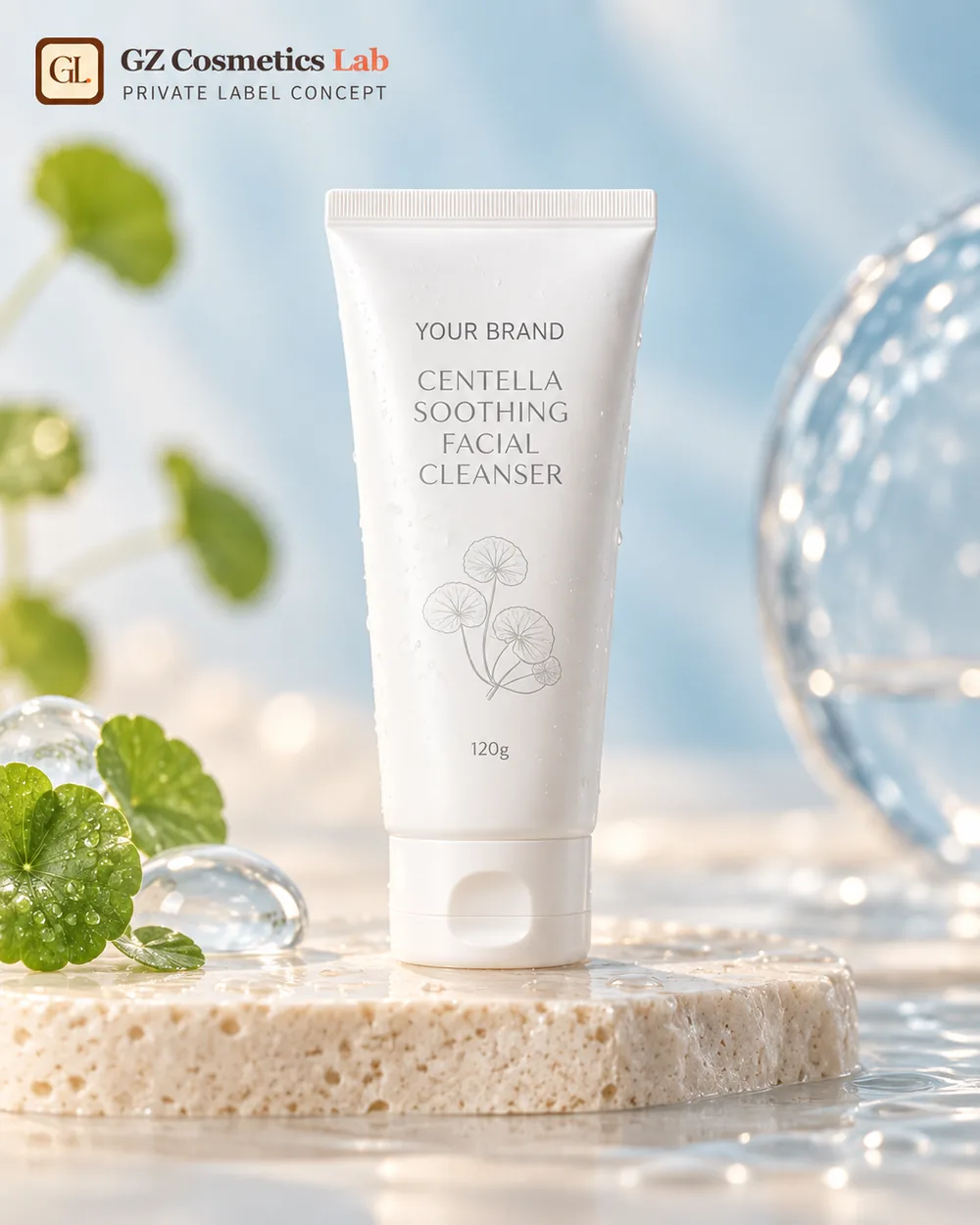
Centella Soothing Cleanser
The standard version is lightly scented; a fragrance-free version is available.
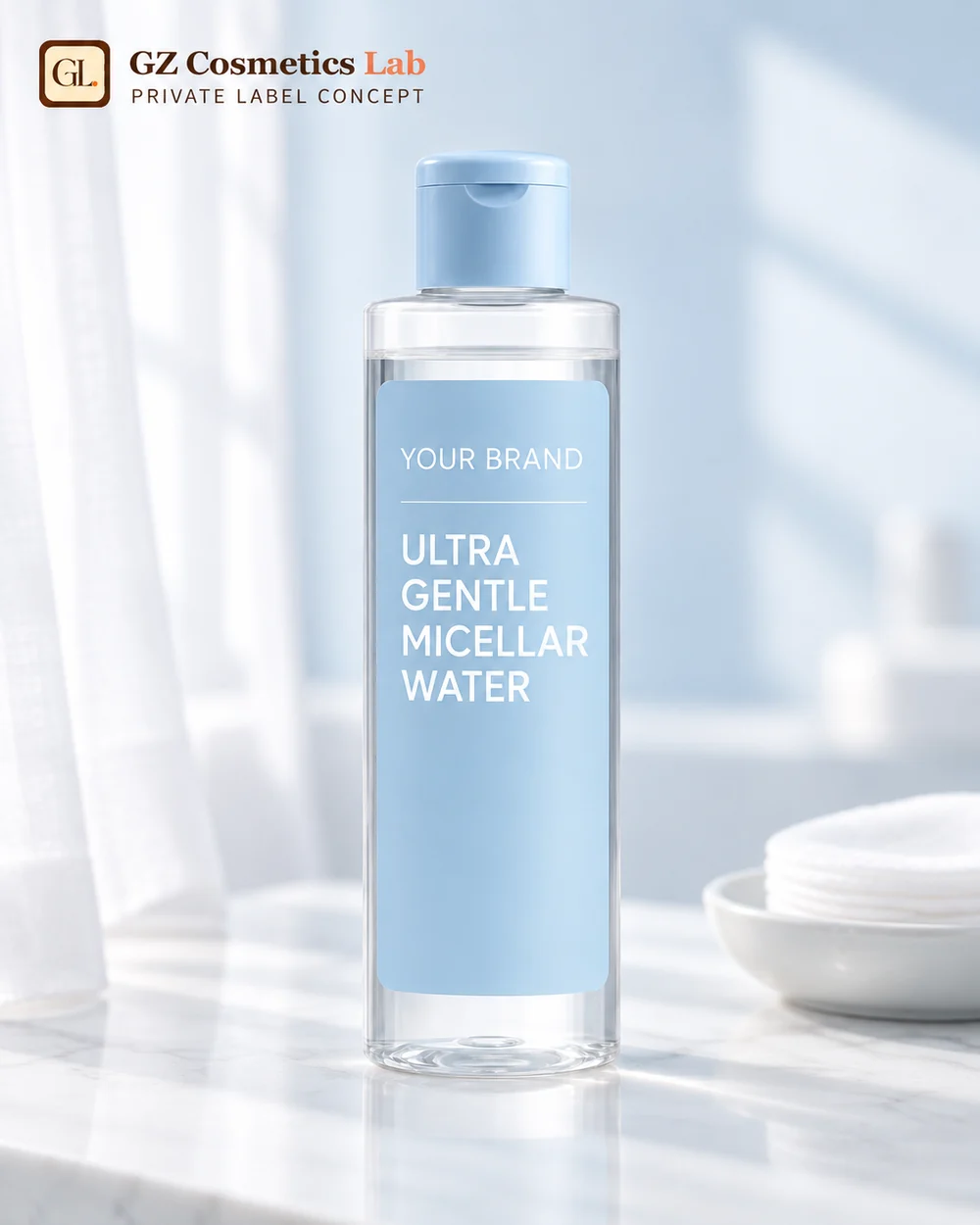
Ultra-Gentle Micellar Water
A micellar format with a fragrance-free option that still requires project-specific claim review.
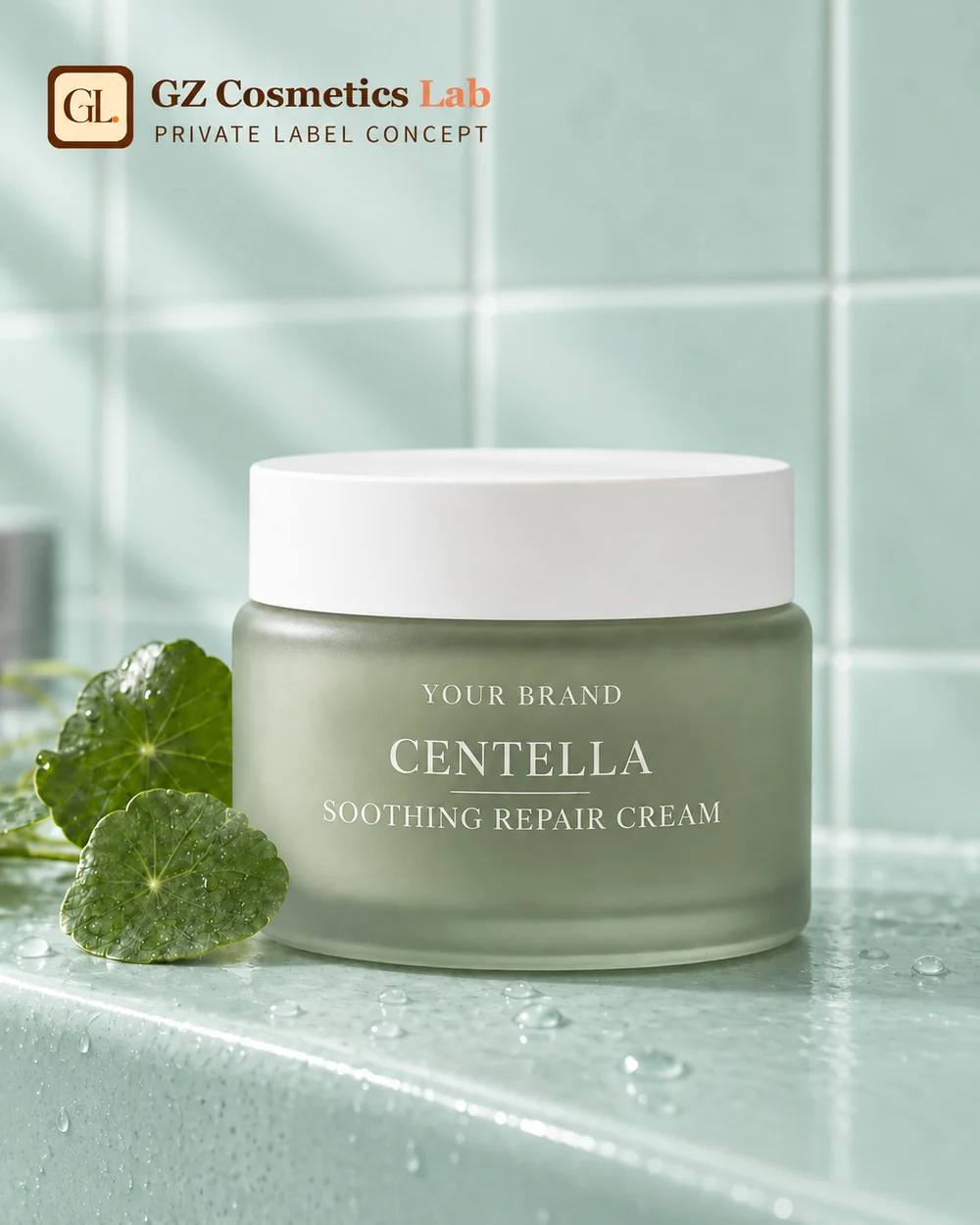
Centella Soothing Repair Cream
Fragrance-free by default, with light fragrance available on request.
These images show GZ Cosmetics Lab catalog references. They are not customer products, clinical evidence or proof that every formula can carry the same claim.
Each example still needs the review described above. The Centella products contain plant extracts, and the brief should state whether any base odor is acceptable. The final claim wording for each market is confirmed against the agreed formula. If you need a formula built from your own brief rather than adapted from a catalog product, our ODM development service covers that route.
Frequently Asked Questions
Is fragrance-free the same as unscented?
No. Fragrance-free usually means nothing was added to give a scent. Unscented usually means the product should not smell of anything, and FDA notes that unscented products may contain fragrance ingredients used to mask other odors.
Is scent-free skincare better for sensitive skin?
It removes one possible cause of a reaction for people who react to fragrance. It does not make a product hypoallergenic or suitable for all sensitive skin, because other ingredients can also cause reactions.
Can a fragrance-free product still smell?
Yes. Oils, butters, extracts, surfactants and some actives have their own odor. A fragrance-free product may smell faintly of its base.
Are essential oils considered fragrance?
They are aromatic plant materials that give a product a scent. FDA has no regulatory definition for essential oils. EU claims guidance says a free from perfume claim should not be used if any ingredient has a perfuming function. A product with essential oils added for scent should not be described as free from perfume under that guidance.
What does no added fragrance mean?
It usually means no fragrance blend or perfuming ingredient was added during manufacture. It says nothing about whether the finished product smells neutral.
How should a brand choose between fragrance-free and unscented on its label?
Start from the formula. If nothing perfumes or masks, fragrance-free or no added fragrance describes it. If the product relies on low-odor materials and smells neutral, unscented may also fit. Have each claim checked against your target markets before artwork is locked.
Start a fragrance-free skincare project
If you are planning a fragrance-free or unscented skincare product, send us your target markets, the scent exclusions you want and the claim wording you have in mind. We will review them against the formula route and reply with a quotation or the questions needed to prepare one.
Request a quote for a fragrance-free skincare project
Sources
- US Food and Drug Administration. Fragrances in Cosmetics. FDA source page (page dated 28 February 2022; accessed 31 October 2026).
- US Food and Drug Administration. Allergens in Cosmetics. FDA source page (page dated 9 October 2026; accessed 31 October 2026).
- US Food and Drug Administration. Hypoallergenic Cosmetics. FDA source page (page dated 25 February 2022; accessed 31 October 2026).
- US Food and Drug Administration. Cosmetics Labeling Guide. FDA source page (page dated 25 February 2022; accessed 31 October 2026).
- US Food and Drug Administration. Cosmetic Ingredient Names. FDA source page (page dated 25 February 2022; accessed 31 October 2026).
- US Food and Drug Administration. Modernization of Cosmetics Regulation Act of 2022 (MoCRA). FDA source page (page dated 29 October 2026; accessed 31 October 2026).
- European Commission. Fragrance allergens labelling. European Commission source page (accessed 31 October 2026).
- Sub-Working Group on Claims, endorsed by the Working Group on Cosmetic Products. Technical document on cosmetic claims, version of 3 July 2017, Annexes III and IV. Official PDF (not a Commission document and not legally binding; accessed 31 October 2026).
- International Fragrance Association (IFRA). IFRA Standards. IFRA source page (accessed 31 October 2026).
Ready to Start Your Project?
Tell us your product requirements. Within 24 hours, our technical team will reply with a quotation or the questions needed to prepare one.